From Research to Farm: How Bentonite Adsorbents Improve Swine Feed Quality and Animal Well-Being

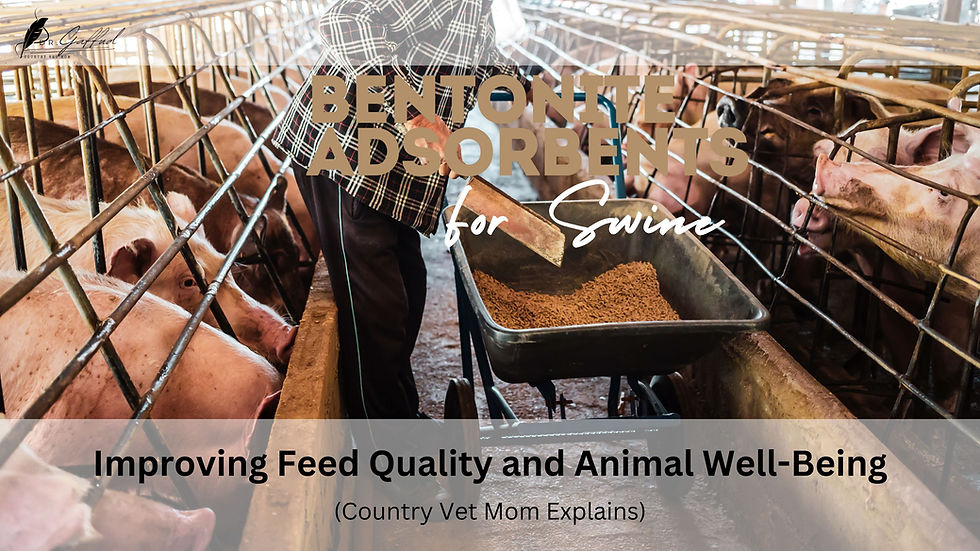
Bentonite adsorbents play a significant role in improving swine feed quality and protecting pigs against mycotoxin contamination. Multiple peer-reviewed studies have demonstrated their efficacy in enhancing growth performance, gut integrity, and overall health while maintaining nutrient digestibility and safety. This article explores the scientific mechanisms of bentonite as a feed additive, reviews recent findings on its application in modern pig nutrition, and connects these insights to holistic animal care practices that promote sustainable and ethical swine production.
_______________________________________________________________________________________________
Keywords: bentonite adsorbent in swine feed, bentonite clay for pigs, mycotoxin binders, swine feed quality, pig health, bentonite feed additive, bentonite in pig diets, bentonite for gut health, toxin binders in pig feed, natural feed additive
_______________________________________________________________________________________________
Table of Contents
Introduction
Understanding Bentonite Adsorbents in Swine Feed
Mechanism of Action: How Bentonite Improves Feed Safety
Research Findings on Bentonite and Pig Health
Enhancing Swine Feed Quality Through Bentonite Use
Holistic Care: Integrating Natural Adsorbents into Sustainable Swine Production
Frequently Asked Questions
Conclusion
References
Introduction: Why Bentonite Adsorbent in Swine Feed
Swine producers continually seek safe and effective feed additives that improve feed quality and animal health. Among these, bentonite adsorbents in swine feed have gained significant attention for their ability to bind mycotoxins, stabilize gut flora, and enhance growth performance (Horký et al., 2021). This natural clay mineral, rich in montmorillonite, exhibits exceptional binding capacity and is widely recognized as a sustainable solution for feed safety in intensive pig production systems.
Understanding Bentonite Adsorbents in Swine Feed
Definition: Bentonite is a natural clay mineral primarily composed of montmorillonite, known for its high surface area and cation exchange capacity (Bettiol et al., 2022).
Purpose: The use of bentonite as a feed additive revolves around its ability to adsorb harmful mycotoxins—secondary metabolites produced by fungi such as Aspergillus and Fusarium—which compromise growth and health in pigs (Puvača et al., 2025).
Listed below is a guide on using bentonite for swine.
Assess Feed Contamination: Evaluate mycotoxin levels in feed ingredients.
Select High-Quality Bentonite: Choose purified or activated bentonite sources to ensure binding efficiency.
Integrate at Recommended Levels: Incorporate within regulated inclusion rates to avoid nutrient interference.
Mechanism of Action: How Bentonite Improves Feed Safety
Bentonite acts as an adsorbent, trapping mycotoxins within its layered structure through physical and chemical binding (Horký et al., 2022). Once bound, toxins pass through the digestive tract without being absorbed, thus reducing systemic exposure (Shin et al., 2023).
In combination with yeast or phytogenic substances, bentonite demonstrates enhanced protection against aflatoxin and fumonisin challenges by supporting liver detoxification and maintaining intestinal barrier integrity (Horký et al., 2021; Deng et al., 2023). This dual mechanism—adsorption and gut health support—positions bentonite as a cornerstone in comprehensive mycotoxin management strategies.
Research Findings on Bentonite and Pig Health
Recent studies reveal significant benefits of incorporating bentonite in swine diets under both experimental and commercial settings.
Growth and Performance: Lopez and Armenta (2025) reported improved sow performance and piglet vitality in farms supplemented with bentonite feed additives.
Safety Profile: Horký et al. (2022) confirmed that next-generation clay adsorbents are safe and do not negatively impact hematological or biochemical parameters in pigs.
Gut Health: Deng et al. (2023) demonstrated that bentonite combined with enzymatically hydrolyzed yeast promotes intestinal health and mitigates chronic effects of fumonisin and aflatoxin.
Nutrient Digestibility: Shin et al. (2023) showed that bentonite inclusion maintained ileal and fecal nutrient digestibility even in wheat contaminated with deoxynivalenol.
Oxidative Protection: Papatsiros et al. (2024) reported improved redox balance and reduced oxidative stress in weaned piglets receiving a multi-component mycotoxin detoxifier containing clays (including bentonite and sepiolite), phytogenic feed additives (curcumin and silymarin), and postbiotic yeast products.
Collectively, these findings illustrate how bentonite supports physiological stability, enhances feed conversion efficiency, and contributes to overall well-being in swine production systems.
Enhancing Swine Feed Quality Through Bentonite Use
Feed quality improvement begins with toxin control. Bentonite’s strong binding affinity for aflatoxin B1, zearalenone, and fumonisin prevents contamination from compromising nutrient value (Bettiol et al., 2022; Puvača et al., 2025).
Feed Stability: Bentonite maintains nutrient composition during storage by reducing moisture and microbial growth (Cao et al., 2019).
Palatability: Bentonite improves the texture and consistency of feed, promoting uniform intake among pigs.
Nutrient Retention: Bentonite preserves amino acid and vitamin integrity against oxidative degradation.
These attributes underline bentonite’s contribution to balanced nutrition and production sustainability, aligning with holistic farming values and animal welfare goals.
Holistic Care: Integrating Natural Adsorbents into Sustainable Swine Production
Holistic swine management emphasizes prevention over treatment. Integrating bentonite adsorbents supports this philosophy by naturally enhancing feed safety, immune function, and environmental stewardship.
Natural minerals such as bentonite and zeolite help reduce ammonia emissions from manure and improve wastewater management in pig facilities (Cao et al., 2019). Additionally, the inclusion of phytogenic blends and probiotics complements bentonite’s action, creating a synergistic approach to animal health and farm sustainability (Yarmots & Belenkaya, 2022).
By aligning feed formulation with environmental responsibility, producers achieve both animal wellness and ecological balance.
Frequently Asked Questions
What distinguishes bentonite from other mycotoxin binders?Bentonite possesses a high cation exchange capacity and specific layered structure, which enables selective adsorption of toxins without binding essential nutrients (Bettiol et al., 2022).
How is bentonite dosage determined in swine diets?Inclusion rates depend on mycotoxin load, feed composition, and regulatory limits established by feed safety authorities (Horký et al., 2022).
Are bentonite adsorbents safe for long-term feeding?Research confirms that activated and purified bentonites maintain safety for extended use, without adverse effects on performance or organ function (Horký et al., 2021).
Conclusion
Bentonite adsorbents represent a scientifically validated, natural, and sustainable tool for improving swine feed quality and animal health. Through effective mycotoxin binding, nutrient preservation, and gut protection, bentonite enhances productivity and welfare in modern pig production systems. Supported by extensive research and aligned with holistic care principles, the integration of bentonite into swine diets exemplifies the intersection of science, sustainability, and animal well-being.
References
Bettiol, P., Cechinel, M., Oliveira, C., Goulart, K., Dol-Bó, A., Bernardin, A., & Peterson, M. (2022). Adsorption of aflatoxin B1 mycotoxins by raw and lyophilized bentonitic clay. Advanced Powder Technology, 33(12), 103682. https://doi.org/10.1016/j.apt.2022.103682
Cao, L., Li, Z., Xiang, S., Huang, Z., Ruan, R., & Liu, Y. (2019). Preparation and characteristics of bentonite-zeolite adsorbent and its application in swine wastewater. Bioresource Technology, 284, 448-455. https://doi.org/10.1016/j.biortech.2019.03.043
Deng, Z., Jang, K., Jalukar, S., Du, X., & Kim, S. (2023). Efficacy of feed additive containing bentonite and enzymatically hydrolyzed yeast on intestinal health and growth of newly weaned pigs under chronic dietary challenges of fumonisin and aflatoxin. Toxins, 15(7), 433. https://doi.org/10.3390/toxins15070433
E.A., I., & O.V., I. (2021). Natural mineral feed for pigs. Pig-Breeding, 17, 19-23. https://doi.org/10.37925/0039-713x-2021-17-19
Horký, P., Nevrka, P., Kopec, T., Bano, I., Škorič, M., Skládanka, J., & Skalickova, S. (2022). Is a new generation of mycotoxin clay adsorbents safe in a pig’s diet? Porcine Health Management, 8, 5. https://doi.org/10.1186/s40813-022-00275-w
Horký, P., Gruberová, H., Aulichova, T., Malyugina, S., Sláma, P., Pavlík, A., Skládanka, J., Škorič, M., & Skalickova, S. (2021). Protective effect of activated and purified bentonite in combination with yeast and phytogenic substances on mycotoxin challenge in pigs. PLoS ONE, 16(11), e0259132. https://doi.org/10.1371/journal.pone.0259132
Lopez, J., & Armenta, L. (2025). PSIV-12 Effect of a bentonite on sow performance in a commercial farm in Mexico. Journal of Animal Science, 103(Suppl 1), 383. https://doi.org/10.1093/jas/skaf102.383
Papatsiros, V., Papakonstantinou, G., Voulgarakis, N., Eliopoulos, C., Marouda, C., Meletis, E., Valasi, I., Kostoulas, P., Arapoglou, D., Riahi, I., Christodoulopoulos, G., & Psalla, D. (2024). Effects of a curcumin/silymarin/yeast-based mycotoxin detoxifier on redox status and growth performance of weaned piglets under field conditions. Toxins, 16(4), 168. https://doi.org/10.3390/toxins16040168
Puvača, N., Nikolić, R., Radojičić, I., Bursić, V., Avantaggiato, G., Tufarelli, V., Pinotti, L., Brkić, I., & Nikolić, S. (2025). Efficacy of dietary mycotoxin adsorbents to toxic effects of zearalenone and fumonisin in weaned piglets. Journal of the Hellenic Veterinary Medical Society, 76(1), 1-10. https://doi.org/10.12681/jhvms.37208
Shin, S., Yoo, S., Song, Y., Park, N., & Kim, B. (2023). Effects of a bentonite clay product and a preservative blend on ileal and fecal nutrient digestibility in pigs fed wheat naturally contaminated with deoxynivalenol. Animals, 13(24), 3752. https://doi.org/10.3390/ani13243752
Yarmots, G., & Belenkaya, A. (2022). The effectiveness of the use of natural mineral additives in the diets of young pigs. Kormlenie Sel’skokhozyaistvennykh Zhivotnykh i Kormoproizvodstvo, 5, 45-48. https://doi.org/10.33920/sel-05-2211-04


Comments